overview
PINNATELY COMPOUND LEAVES
A pinnately compound leaf refers to a type of compound leaf where the blade (edge of the leaf) is divided into smaller leaflets that are arranged along the central stalk (the rachis). This can best be described as resembling the hairs on a feather. Leaflets on pinnately-compound leaves grow opposite each other (i.e. directly across). They may or may not have a leaflet at the top of the leaf, called a terminal leaf.
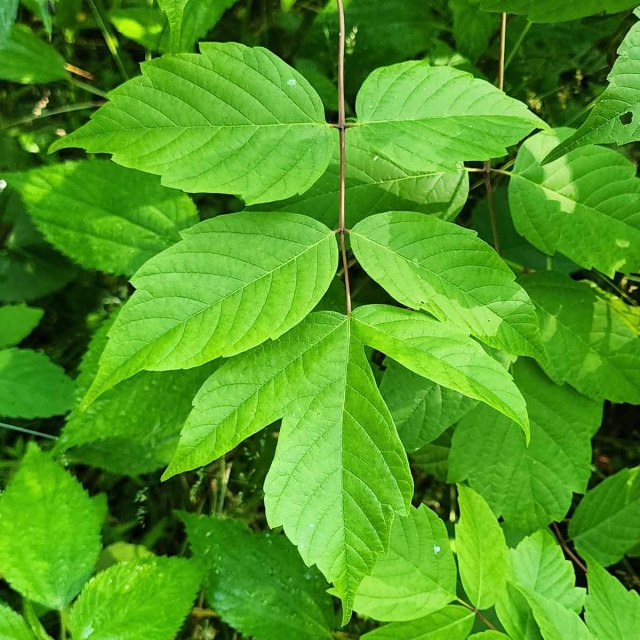
Native Ohio Trees with Pinnately Compound Leaves
The leaves on the left belong to the Black Walnut, which you can see does not have a terminal leaf. Leaves on the Black Walnut are large, yellow-ish green in color. They typically have anywhere from 11-23 toothed leaflets, and do not have a terminal leaflet.
The middle photo shows the leaves of a Hickory are also quite large, but have many fewer leaflets than the Black Walnut at around 5-9 per leaf. Hickories also have a terminal leaflet and finely toothed margins.
The rightmost photo shows a typical Box Elder leaflet, which has anywhere from 3-7 leaflets that are 2-4 inches long, lobed, and with serrated margins. Box Elders have a distinct terminal leaflet.