• Identifying Trees: Where to Begin

    Identifying Trees: Where to Begin

    1. Start with the Big Picture
    Before focusing on tiny details, observe the tree’s overall shape, height, and branching pattern. Some species have sweeping, rounded crowns, while others grow tall and narrow or have branches that angle upward in a distinctive way.

    2. Examine Leaves or Needles
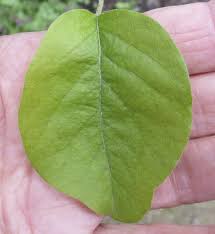
    Leaves offer some of the clearest clues. Look at their shape, margin, and arrangement on the twig (opposite, alternate, or whorled). Evergreen species like pines or spruces can be identified by needle length, grouping, and texture.

    3. Study the Bark
    Bark is a surprisingly reliable identifier, especially when leaves aren’t present. Its color, texture, and pattern—smooth, ridged, flaky, peeling, or patchy—often point directly to specific species.

    4. Notice Buds, Flowers, and Fruit
    Buds can be tiny but incredibly distinctive. Flowers, catkins, cones, berries, and seed pods all add helpful clues—think of maples with their winged samaras or oaks with their acorns.

    5. Observe Habitat and Location
    Where the tree grows can be just as telling as what it looks like. Some species prefer wet soil, others thrive on dry ridges, and many have geographic ranges that narrow down the possibilities.
  • Identifying Trees Using Leaves

    Identifying Trees Using Leaves

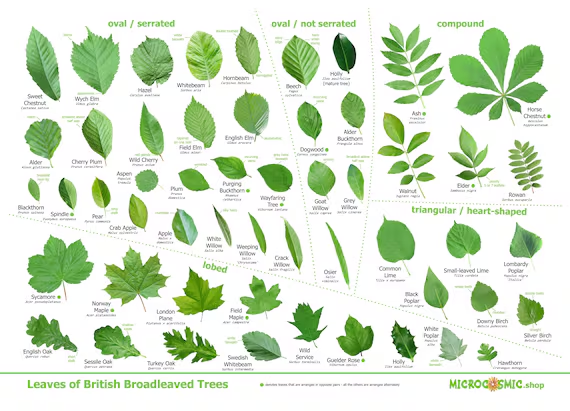
    Leaves are one of the most revealing features of a tree, and learning to read their shapes and edges can turn a simple walk into a botanical treasure hunt. By paying attention to two key traits—shape and margin—you can quickly narrow down the species you’re looking at.

    1. Start with Overall Shape
    Leaf shapes vary widely: oval, lobed, heart-shaped, needle-like, or fan-shaped. Maples, for instance, have distinct lobes that form a hand-like shape, while dogwoods show off smooth, oval leaves with curved veins.

    2. Study the Leaf Margin (Edge)
    The margin is where details shine. Edges may be smooth, serrated (toothed), wavy, or lobed. Elm leaves often have sharp, saw-toothed margins, whereas magnolias tend to have broad, smooth edges.

    3. Look for Symmetry and Veins
    Some leaves, like those of the American basswood, are asymmetrical at the base. Others display very regular, radiating veins—ginkgo leaves are known for their fan shape and neat vein patterns.

  • Identifying Trees Using Bark

    Identifying Trees Using Bark

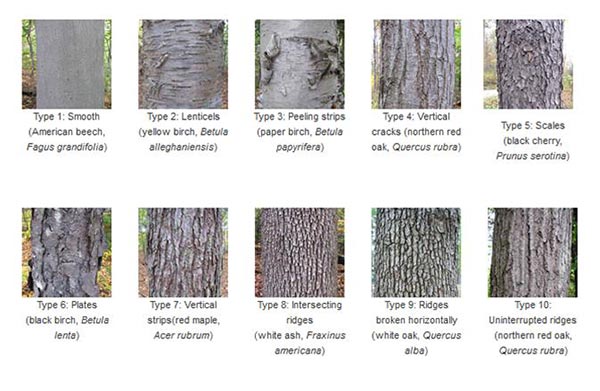
    When leaves are out of reach or missing altogether, bark becomes one of the most reliable clues for identifying trees. Each species has its own distinct texture, color, and pattern.

    1. Look at Texture
    Tree bark can be smooth, furrowed, plated, or exfloiating/peeling. For example, beech trees have smooth, gray bark, while mature oaks tend to develop deep ridges and furrows.

    2. Notice Color and Sheen
    Some bark is strikingly colored: birches often show pale white or yellow bark that peels in papery strips, whereas cherry trees may have a reddish-brown bark with a glossy sheen and horizontal lines.

    3. Examine Patterns
    Patterns can be the biggest giveaway. Sycamores show patchy, camouflaged bark as outer layers flake off. Pine species differ too—some have rectangular plates, while others feature rough, irregular patterns.

    4. Check for Unique Traits
    Certain trees have unmistakable quirks: shagbark hickories develop long, curling strips that hang from the trunk, and American Sycamores can shed bark dramatically in colorful sheets.

    5. Use Touch as Well as Sight
    Feel the bark—some species are noticeably soft, spongy, or fibrous. Texture adds another dimension that photos alone can’t capture.

    Learning to identify trees by bark turns winter walks and leafless forests into a discovery game. With a bit of practice, you’ll start recognizing familiar trunks long before the branches or leaves give them away.

  • Types of Leaves

    Types of Leaves

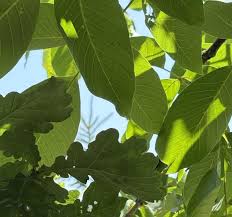
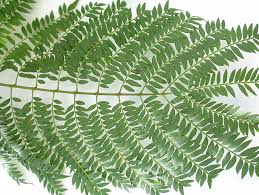
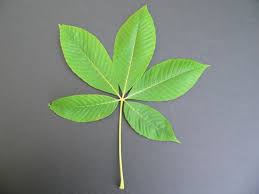
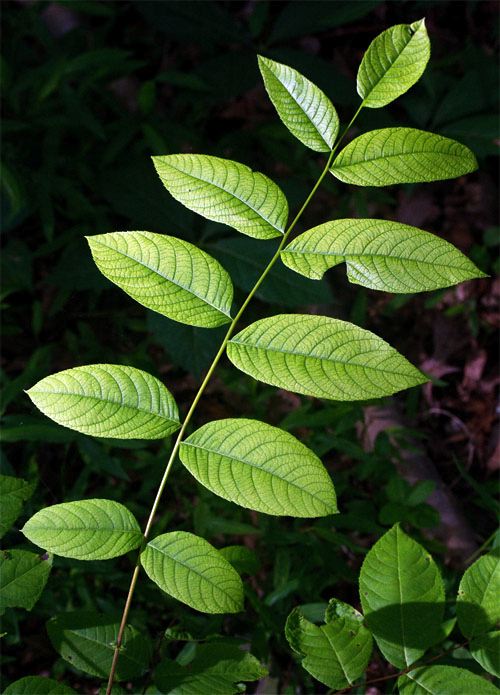
    One of the easiest ways to identify a tree is by the type of leaf it has. To start, we’ll look at the broadest categories: simple leaves and compound leaves.

  • Welcome, Dendrophiles!

    Welcome, Dendrophiles!

    Whether you’re a hiker wandering through state parks, a homeowner curious about the tree in your backyard, a student studying local ecosystems, or simply someone who loves the outdoors, this site is designed to help you begin to identify some of the trees that shape Ohio’s landscapes.

    🔍 What You’ll Find Here

    This website has pages on common characteristics to look for when identifying trees and other woody plants. Although not exhaustive by any means, it is meant to serve as an introductory guide for beginners and amateurs alike.

    🌲 A Place for Curiosity

    You don’t need to be a botanist to appreciate the trees around you. All you need is curiosity. My goal is to help you look more closely, learn something new, and connect with Ohio’s forests in a meaningful way.

    🍂 Let’s Explore Together

    I’m glad you’re here, and I hope this site becomes a helpful companion as you learn to identify the trees that surround us every day. Feel free to explore, ask questions, and return often—there’s always something new growing in Ohio’s great outdoors.

    Welcome, and happy tree spotting! 🌿